







Gunfire Reborn review
June 01, 2022 by RSS Feed
Gunfire Reborn is a roguelite first-person shooter that's entirely focused on loot. In each run, you are constantly finding various weapons, ability upgrades, and passive modifiers in an effort to mold yourself into the perfect soldier to battle against waves of increasingly complicated and powerful waves of enemies. The experience at times can feel like a slow burn, but Gunfire Reborn is quite possibly the best way to do some cooperative shooting on mobile.
Furry FPS
There is very little setup to Gunfire Reborn. You play as one of a handful of gun-toting anthropomorphic animals who are tasked with blasting their way through dungeons and slaying bosses. There's no real story that unfolds along the way, unless you count the evolution of the loadout and abilities you equip to your character.
As you load directly into new biomes to fight the next sets of tough enemies, you need to keep your weapons and abilities up to snuff. Enemies may drop random weapons with procedurally generated modifiers like "50% chance to spawn a ball of lightning" or "reloads 75% faster off an empty clip" and certain levels have chests, hidden stages, or predictable checkpoint spots where you can pick up passive talents and spend coins you've been collecting to upgrade your existing gear, heal up, etc.
Multiplayer mayhem
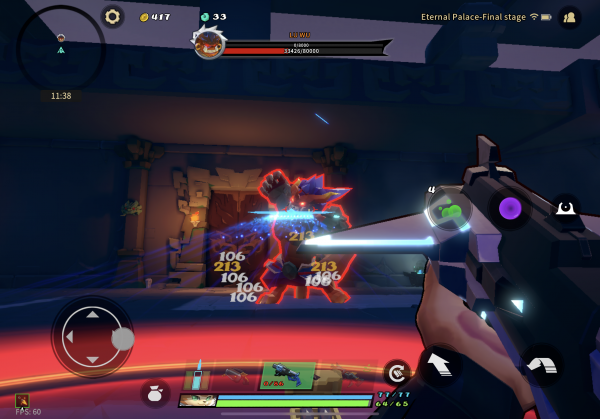
As a shooter, Gunfire Reborn isn't particularly complicated. There's some basic traversal options and a few guns with unique firing mechanics, but most of the game is reliant on your ability to circle strafe or use environmental cover effectively while being smart about how to tune your character with the random upgrades you find along the way. Between runs you also get the ability to spend a special currency on unlocking and upgrading abilities that provide permanent power boosts to help you get further along each time you start a new game.
The run, gun, die, repeat loop of Gunfire Reborn is nothing new, but it helps that its guns and abilities intertwine with an elemental system that adds a lot of variability to how you build your characters on each run. Also, perhaps the biggest plus side of the game is its ability for up to four players to team up on runs, which makes for a more chaotic experience that feels less like you're stuck on an endless upgrade treadmill... at least by yourself.
Longtime looter
There are definitely unique aspects to how Gunfire Reborn's abilities work, but if I had to lay a complaint about the game it's that so many of them are passive or simply reliant on procedural generation to the point that none of them really work to make the game feel unique to control. The voxel-like in-game graphics also don't help the game look unique, as they somewhat deaden a lot of the inspired character and art direction present here.
On a final note, it's worth noting that Gunfire Reborn may feel best with other players, but run lengths can go on for over an hour which might be hard to manage playing on a mobile device. If you're playing single player this is way less of an issue, especially since Gunfire Reborn has a good checkpointing system, but playing solo can also definitely makes the game feel a lot less lively.
The bottom line
The best times I've had with Gunfire Reborn were when I set aside the time to matchmake with other players and play an extended session. I'd even go as far to say it's now my go-to cooperative game. The game is still enjoyable as-is playing solo, but the long upgrade treadmill and somewhat generic look and feel can make the single player experience feel a bit dull by comparison.
Source link:https://www.148apps.com/reviews/gunfire-reborn-review/
credit : 148apps


Who Muted Uncle Marcus? review
May 25, 2022 by RSS Feed
Wales Interactive have firmly established themselves as some of the most prolific FMV developers out there, putting out three titles on the App Store last year and already ushering in an absurd virtual party-turned-murder-investigation with Who Muted Uncle Marcus? in early 2022. This game puts you in the shoes of Abby as she grills her eccentric relatives after a family meeting where a deadly plot unfolded. Despite a concept that should set the stage for a fun locked-door mystery, Who Muted Uncle Marcus? feels forced and arbitrary at almost every turn.

Family farce
Who Muted Uncle Marcus? is a game that takes place over a virtual meeting in celebration of Abby's mother's birthday. The game quickly establishes that this kind of call is a family tradition and that it is also conducted in the format of a quiz game, with each family member taking turns to host a round of questions while the others compete for points.
As Abby prepares for this call, she gets another from the black sheep of the family: Uncle Marcus. Marcus calls to tell Abby that he has been poisoned and that the culprit has to be someone in the family. This sets you off on an adventure where you not only try to navigate the quiz game and Abby's family drama, but also try to identify the killer and discover how to prevent Marcus from dying.
Quiz or question?
Like most conventional FMV games, Who Muted Uncle Marcus? presents you, the player, with video clips of all of this action playing out with real-life actors. The action only somewhat pauses (or actually pauses if you use the "Streamer Mode" game option) when you--as Abby--can make a choice about how to proceed forward. For the vast majority of this game, your choices revolve around who you want Abby to pair up for certain quiz rounds with and whether or not you want to try and play the family quiz or shift the conversation toward gathering information about the family meeting that led to Marcus's poisoning.
By the end of the game, you get the chance to accuse certain family members of doing the foul deed, provided you've gathered enough evidence to make a case against them. Then you are treated to one of the game's many endings before being invited to play the game again to try gathering new evidence to unlock other endings.

Abitrary arbitration
Right from the outset of Who Muted Uncle Marcus?, it feels like the creators are not confident in their setup. The script has Uncle Marcus comment on the weird rules of the quiz game (which are clearly the way they are so that you can rotate between people to talk to), and the choices in the game don't align with any particular logic to allow you to actually play detective like you might expect. As a result, the whole thing feels like an arduous and random choose-your-own adventure as opposed to an adventure that asks you to investigate or clue-in on certain aspects of character behavior.
After my second playthrough of the game, I realized that I didn't really care at that point who tried to kill Uncle Marcus. The process of revisiting conversations to unlock new evidence from Abby's cartoonishly horrible family would have been a big ask even if there was a logic to intuit about how to get each character to spill the beans. Instead, some unlocks come by purposely getting certain quiz answers incorrect or not even trying to ask about the family meeting at all. There are also some logic holes I discovered where certain clips talk about information that you may not have actually discovered yet. This all gets exacerbated by the frustrating way in which a clip-skipping system works on repeat playthroughs (which only allows you to pass by certain sections of the game in a blink but makes you watch other segments in their entirety for reasons that don't make a ton of sense).
The bottom line
The concept for Who Muted Uncle Marcus? is fun and full of intrigue, but all that feels squandered when you don't actually feel like you're in control of any investigating. It feels more like a toy you are supposed to poke and prod at until you eventually find out what happens, though it's easy to lose interest in doing that considering the characters and game features you have to deal with to do that.
Source link:https://www.148apps.com/reviews/who-muted-uncle-marcus-review/
credit : 148apps

Cat Museum review
May 25, 2022 by RSS Feed
Calling this game Cat Museum is almost a misnomer. Although this breezily paced adventure game features cute cats and a museum of sorts, its landscape also contains a ton of surreal and messed up creatures and locations that are constantly at odds with the game's pleasant color palette and storybook aesthetic. This clash is one of many intriguing aspects of Cat Museum, though the game doesn't quite stick around long enough to feel like it follows through on all of the ideas it plays with.

Eerie exhibits
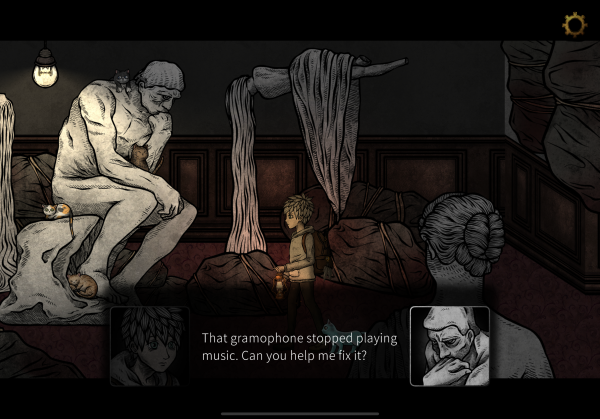
In Cat Museum, you play as a mysterious boy who just so happens to find themselves in the most bizarre "museum" you can think of. It has artwork on display, but all of them are grotesque interpretations or reimaginings famous works. Some of them are simply hanging on the walls, but others are turned into peek-through photo spots, have eyes that follow you, or are just paintings that have literally come to life and can speak with you.
On top of the strange art there are giant killer monsters with hands for feet, a room built out of giant red blood cells, beds made out of body parts, etc. There's nothing about this place that isn't unsettling, save for some cats. It's not entirely clear why you are in this museum, but making your way through it with the help of a magical, glowing cat seems to be the key to discovering something about the main character and his past.
Streamlined spooks
To make your way through Cat Museum, all you have to do is tap on which side of the screen you want the boy to move in and interact with the objects you come across. Many objects simply add some more flavor and commentary on the game world, but others initiate puzzles that unlock new ways forward. None of these puzzles are particularly challenging from a design perspective, but almost all of them feature you interacting with some horrific tools or creatures.
On that note, I wouldn't say Cat Museum is a particularly scary game. It is clearly designed to make players uncomfortable, but--even with a few designed monster chase sequences--no part of the game feels especially tense or stressful. In fact, the puzzles and challenges seem deliberately low-stakes and straightforward, even though they can involve popping zits on a face embedded in a creatures back or scooping worm-laced popcorn out of a claw machine with human hands for claws.
Curious conclusion
Cat Museum seems very intentionally designed to keep you from ever getting hung up on its simple challenges. With the exception of one puzzle I had to look up the answer to (as the game has no hint system whatsoever), it is very easy to blaze through the game in one sitting. From an exploration perspective, this is wonderful. It keeps any its visuals from losing their shock value and provides momentum to carry you through the whole thing quite easily.
That said, the one barrier I ran into while playing was a doozy and disrupted my flow through the experience considerably. I'll also say that Cat Museum could have done a little more work at the end to connect the dots and spell out its ending a bit more. I'm all for stories that want to leave things up for interpretation, but not when the conclusion being suggested is so vague that you don't have much to interpret.
The bottom line
All told, I'm very taken with Cat Museum's dedication to bizarre art design and swift pacing in the adventure game format. I would have loved to see a little more refinement on the puzzle design or perhaps some convenience features to prevent any downtime and perhaps a but more substance to the narrative payoff, but the tone and presentation of Cat Museum's bizarre adventure is still plenty satisfying as it is.
Source link:https://www.148apps.com/reviews/cat-museum-review/
credit : 148apps
Fury Unleashed review
May 25, 2022 by RSS Feed
Over the years, video games have primarily focused on granting power fantasies to players by putting them in the shoes of ultra-powerful killing machines. With all of that practice and iteration, games have gotten increasingly refined in their ability to make players feel good about creating various forms of wanton death and destruction. Fury Unleashed is a game practically obsessed with delivering a very straightforward version of shooting action that positively reinforces ripping through enemies as quickly as possible, and it does a really great job at it, especially in adapting its gameplay to touch screens.
Comic book action
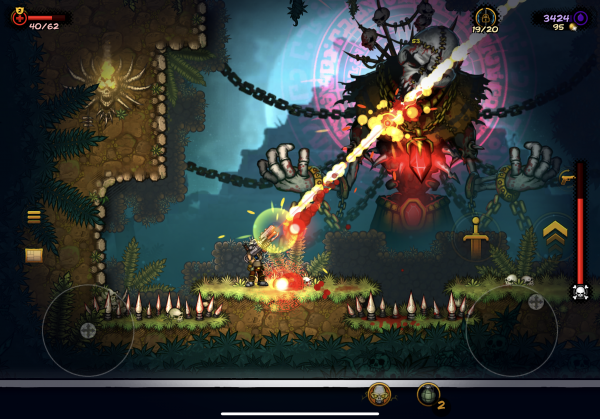
Fury Unleashed is a 2D side-scrolling shooter that is built around the aesthetics and design of comic books. You play as the book's protagonist, Fury, and wander between different comic panels, laying waste to skeletons, aliens, nazis, and more. Fury is a super-soldier of sorts who is well versed in all manner of firearms while also having melee weapons, grenades, and super powers at their disposal.
As you make your way through the pages of various comic issues, a light story unfolds, though it's focused more on the fictional creator of these comic books rather than Fury themselves. Rest assured, though, the focus here really is on the moment-to-moment action of unloading bullets in rooms full of enemies, gathering gear along the way, and seeing how far you can make it before you die.
Retro roguelite
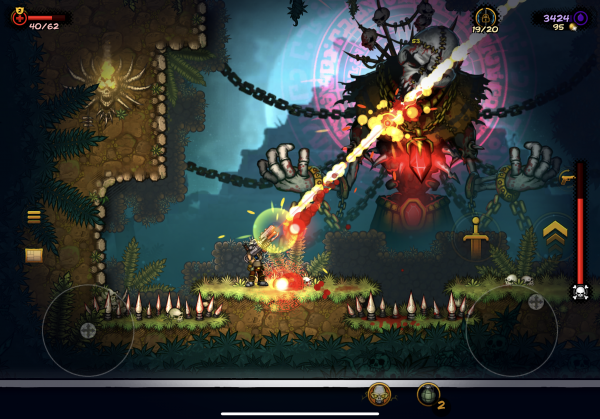
The action in Fury Unleashed feels like the gameplay of classic 2D side-scrolling arcade games like Contra and Metal Slug, though with some key differences like independent control of movement and aiming via two virtual joysticks. There's also a gear system in place here that has you discovering and equipping various forms of armor, grenades, power ups, and up two gun options you can swap between on the fly.
This sounds like a lot to handle via a touch screen, but Fury Unleashed's mobile version is surprisingly pretty easy to wrangle (not to mention it also has perfect bluetooth controller support). There aren't a ton of control customization options, but the granular auto-aim settings can really help you fine-tune the degree of compensation you might need when using virtual buttons. If even then things seem too difficult, Fury Unleashed grants you upgrade points after every run that you can use to give yourself bonuses and increased stats on subsequent play sessions, and there's even somewhat of a "checkpointing" system that lets you skip to later levels provided you've cleared the previous ones enough times.
Combo breaker
I can't stress enough how well Fury Unleashed's touch controls work. For the purposes of this review I was able to complete every section of the game on its default "hard" difficulty without touching a controller. Everything from jumping to tossing grenades feels easy to master with perhaps a little bit of practice, and my only consistent hiccups during play mostly came from accidentally opening the the quick-access map, which unfortunately isn't moveable or able to be toggled on/off despite having some customization options for those that play with controllers.
Otherwise, the only thing that might make Fury Unleashed's action feel a little divisive is the game's combo system. Although you can absolutely play this game by cautiously and methodically working your way through levels, it heavily encourages you to string kills together as quickly as possible while avoiding damage. Currencies that help you during runs and generate ability points between them drop more plentifully from enemies the higher your combo meter is. Some ability upgrades are also specifically tied to granting bonuses based on your combo. I don't necessarily mind this gameplay model--especially as it adds some additional challenge to a game that at times can feel a little easy for a roguelite--but it can lead to some frustrating runs where the flow of enemies doesn't quite work your way or a slip of the finger results in dropping a huge combo string that you can't help might have been avoidable playing on a different platform.
The bottom line
Fury Unleashed does a fantastic job of delivering quick, high-octane roguelite action that feels varied, deep, and manageable on a touch screen. It may not be the most original kind of game out there, nor will it necessarily push your skills to their limits, but it is a bloody good time nonetheless.
Source link:https://www.148apps.com/reviews/fury-unleashed-review/
credit : 148apps

GrubDash Driver review
May 25, 2022 by RSS Feed
I think we can all agree the gig economy sucks, but GrubDash Driver is a game that goes out of its way to reinforce that point. This management game puts you in the shoes of a delivery driver trying to make ends meet and it is a grueling, soul-crushing experience in both concept and practice. Because the game is so painful to play, though, I'm not sure players might stick with it long enough to glean or appreciate anything about what it has to say beyond its initial (and rather obvious/agreeable) assertion.

Grueling gig
In GrubDash Driver, you play as someone who just lost their job and has to resort to working as a GrubDash driver. GrubDash is this game's fictional food delivery app that more-or-less acts the same way as services like GrubHub and DoorDash operate in real life. Individuals request orders through the app which then go to you, and you have to drive to establishments to pick up said orders and then deliver them to the person that requested them.
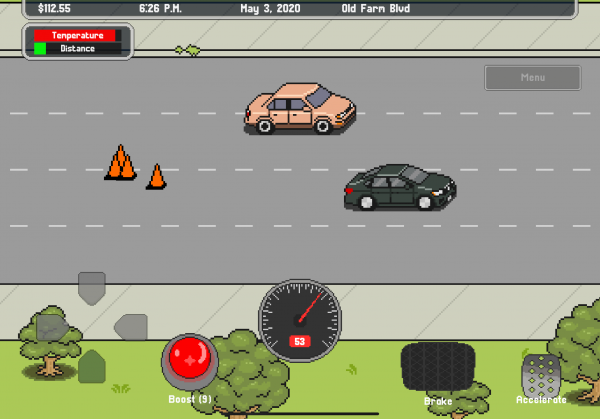
It's a job that is repetetive but requires a lot efficiency if you want to score tips or simply not be late with your delivery, and this is reinforced by nearly every single one of GrubDash Driver's mechanics. Every delivery starts with a push notification on your in-game phone, followed by a "getting ready" phase where you make sure you have everything you need before leaving the house. From there, you drive to town where you automatically find parking, but then have to wander through streets to find the correct establishment. After playing a "food pickup" mini game that determines the food's freshness rating, you then have to book it across town in a driving sequence that feels as unresponsive as it possibly can. Once in the neighborhood, you wander between houses reading addresses before dropping the order off at its final location, where you have to make small talk with the recipient before moving on to the next order.
In pursuit of perfection
GrubDash Driver is essentially designed to make you in a constant rush to try in an attempt to beat the clock. Delivery time windows are small, and no pickup or drop-off locations have consistent geography to allow you to rely on player knowledge to take shortcuts. When you first start out, you may consider yourself lucky to get food delivered at all, even though arriving early, maintaining freshness, getting client names correct, etc. can score you the coveted tips you need to really start earning any significant amount of funds.
These funds you then turn around and use on upgrades to make you marginally better at carrying out deliveries. There are also options to spend funds on paying down debt or upgrading your house, but those ends aren't tied to any gameplay systems and are almost treated as vanity expenses. As a result, there is heavy incentive placed on buying new cars that drive better or paying for upgrades that let your character read better, walk faster, etc.
Maddening messaging
I definitely appreciate the way that GrubDash Driver presents the idea of the gig economy as a driver. It is miserable even when you are finding success and it's outlandish to think anyone can simply optimize their way through it to create upward mobility. All that said, GrubDash Driver goes too far to make experience of playing it miserable while also allowing for optimization to occur that it seems to mix up the messaging it appears to be going for.
By making the process of delivering food absurdly difficult (and in some ways that don't make real sense) but offering the ability to purchase upgrades that ease that difficulty, GrubDash Driver seems to suggest that the gig economy is--in fact--something that can be gamed, even when designed to work against you at every turn. There's definitely enough written text in the game to communicate very clearly that the takeaway from this shouldn't be that you can succeed in the gig economy if you try hard enough, even though GrubDash Driver is precisely structured to reinforce that (misguided) belief.
The bottom line
GrubDash Driver is a maddening critique of the gig economy because it gives players goofy and terrible-feeling mechanics to illustrate the difficulty of the work while still granting rewards that you can freely reinvest into making the work easier to perform, netting you more profits. It's a strange way to try and communicate the struggle of the gig worker since it ultimately does allow for you to make meaningful career and life advancement so long as you put up with it for long enough.
Source link:https://www.148apps.com/reviews/grubdash-driver-review/
credit : 148apps

Follow Mid Atlantic Consulting


Subscribe Mid Atlantic Consulting







APP review today